
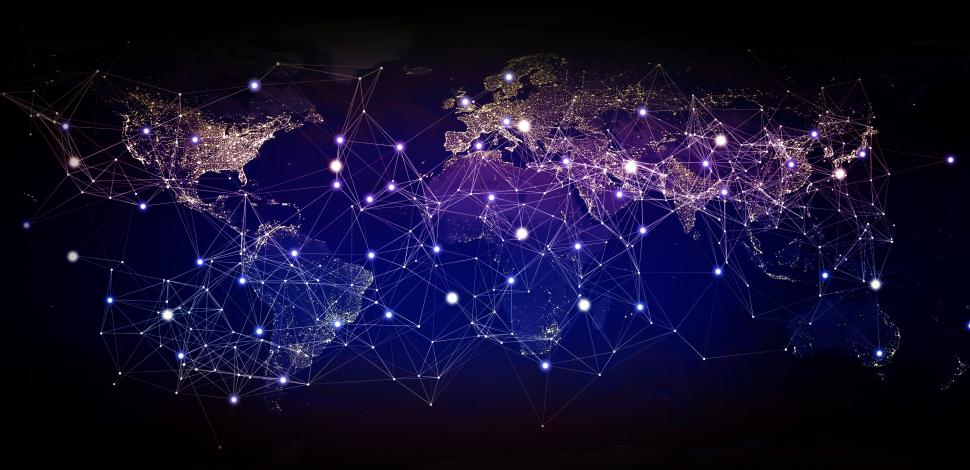
There’s no doubt about it. The internet has absolutely revolutionized the way we live, work, and communicate. With billions of users worldwide, it has become an integral part of our daily lives.
But who remembers the days of driving with map in one hand, steering wheel in the other? Thank you Google Maps. Or what about the times when you couldn’t end a heated debate by whipping out your iPhone to Google the answer? No I’m too young for that too.
In this post, we delve into the intriguing world of the web. From mind-boggling numbers to astonishing milestones. So let’s embark on a journey to discover the most amazing facts about the internet.
At a Glance

- Internet Usage
- The Internet is Born
- Social Media Dominance
- Global Internet Penetration
- Mobile Internet
- E-Commerce Boom
- Internet of Things (IoT)
- Online Video Streaming
- Cybersecurity Challenges
- Internet Speeds
- Online Language Diversity
- The Power of Search
- Internet Censorship and Freedom
- Green Internet Initiatives
- Submarine Cables
- Websites and Web Pages
- Wrap it Up
Internet Usage
On average, people spend around 6 hours and 54 minutes online each day, which amounts to roughly one-quarter of their waking lives.
So I guess some of us spend longer online than they do sleeping which is deeply concerning. You know who you are.

Our online addictions include browsing, social media engagement, streaming content, online shopping, and exploring our website of course.
In terms of global internet traffic, recent estimates suggest that it exceeds 200 exabytes per month (1 exabyte = 1 billion gigabytes). No we don’t understand this either but it sounds like a lot.
The Internet is Born
The birth of the internet can be traced all the way back to the 1960s, when the concept of connecting computers in a network was first explored. Some clever folks wanted to create a decentralized communication system that could survive a nuclear attack. Fortunately that was never required.
But the first link was established in 1969 between the University of California, Los Angeles (UCLA) and the Stanford Research Institute (SRI). This connection allowed researchers to exchange data and collaborate on projects which luckily was all they could share.

In the early 1970s, email protocols were developed, allowing users on different computers to send messages to each other. This was a significant milestone in the development of the internet as it enabled efficient communication across the network, such as organising post-work drinks.
In 1983, a major milestone was reached with the adoption of the TCP/IP protocol suite (Transmission Control Protocol/Internet Protocol if you want to impress your friends). This provided a standardized set of rules for transmitting and receiving data over networks, allowing different types of computers to communicate with each other. This marked the birth of the modern internet.
Throughout the 1980s and 1990s, the internet continued to grow, with the development of the World Wide Web by Tim Berners-Lee in 1989. This brought a user-friendly interface to the internet, making it accessible to a broader audience.
The introduction of web browsers and the ability to navigate hyperlinked pages revolutionized how people interacted with information and services on the internet. But we had to wait until 2005, the year YouTube was born, until we could start enjoying videos of each other’s children and pets.
Social Media Dominance

Social media platforms have become an inseparable part of our digital existence. Except Myspace of course.
In 2021, more than 4.9 billion individuals were active social media users, equating to approximately 63% of global internet users. Facebook now boasts over 2.85 billion monthly active users, followed by YouTube with 2 billion users and WhatsApp with 2.1 billion users.
Instagram, Twitter, LinkedIn, and Snapchat each have over 300 million active users.
And Myspace has around 50.
Global Internet Penetration

As of 2023, over 5 billion people worldwide, or 63% of the global population, have internet access. This staggering number represents a significant increase from the roughly 2 billion users in 2010 and an even more impressive increase from 0 in 1960.
Asia boasts the largest number of internet users, with China leading the pack at over 1 billion users. It’s no wonder China runs camps for those addicted to the internet. No seriously, Google it.
China is closely followed by India with around 700 million users which coincidentally is the same number as those oh so cultured Europeans.
Internet penetration rates vary across regions with the unlikely trio of Saudi Arabia, Norway and U.A.E. leading the rankings. An impressive 99% of their populations have access to the web in 2023.
The Swiss follow closely with a penetration rate of 98.4%, while the great Danes rank third at 98.1%. Clearly they need to get out more. Kenya have the lowest penetration rate where just 1 in 3 people has access to the internet.
Since two thirds of the population have access to the internet, this means a staggering 2.5 billion people do not!
Mobile Internet

iPhones, aka mobile devices, have revolutionized internet access, enabling people to stay connected on the go.
Mobile internet usage continues to soar, with around 5.48 billion unique mobile phone users worldwide.
Mobile traffic accounts for around 60% of all internet traffic. This figure is even higher in developing markets such as Asia and Africa.
E-Commerce Boom

The rise of e-commerce has transformed the way we shop. Global e-commerce sales reached a staggering $5.2 trillion in 2021, a 21% increase compared to the previous year.
China leads the e-commerce market, with its Singles’ Day (November 11th) generating a record-breaking $134 billion in sales on that one day in 2021!
Furthermore, Amazon, the world’s largest online retailer in case you haven’t heard of them, reported $470 billion in net sales and accounted for more than 45% of all e-commerce sales in the United States for the same year. That’s a lot of cheap tat.
Mobile commerce (m-commerce) is unsurprisingly on the rise, with mobile devices accounting for 73% of e-commerce sales worldwide.
Internet of Things (IoT)

The Internet of Things refers to the network of interconnected devices embedded with sensors and software, enabling them to exchange data and perform automated tasks. For example, if your fridge was hooked up in this way it could automatically order more of your favorite beer when you run out!
Whilst this technology may feel a way off, did you know you probably already use at least one IoT device? In fact, the first IoT devices were ATMs. Kaching!
The number of IoT devices is projected to reach 75 billion by 2025. Smart home devices, wearables, industrial sensors, and connected vehicles are just a few examples of the rapidly growing IoT ecosystem.
However, the coolest IoT device has to be smart homes, of which there are hundreds of millions worldwide!
Think IoT is a recent term? Think again. It was coined by a British engineer named Keith Ashton way back in 1999, right about the time we wish we’d all been investing in Google.
Online Video Streaming

The popularity of online video streaming platforms continues to surge with video streaming accounting for 82% of all internet traffic.
Yes we should have invested in YouTube too, which coincidentally, is the largest video-sharing platform. It receives over 30 million daily active users, who collectively watch over a billion hours of video content. Yikes.
And Netflix, which you’ve probably not heard of yet, has approximately 250 million paid subscribers worldwide in 2023. These figures highlight our increasing reliance on digital entertainment and our inability to pick up a book.
Cybersecurity Challenges

As our dependence on the internet grows, so does the need for robust cybersecurity measures.
The number of cyber-attacks is escalating, with over 1 million ransomware attacks occurring daily in 2022!
And data breaches exposed over 37 billion records in the same year, affecting individuals, businesses, and governments worldwide. This caused an annual loss of over $1 trillion globally.
But the most costly breach was that of Epsilon in 2011 with a total price tag in the region of $4 billion dollars. Ouch! Must have been a tough day in the office.
And the global cost of cybercrime is projected to reach $10.5 trillion annually by 2025. So start saving now.
Internet Speeds

Access to high-speed internet has become crucial for individuals and businesses alike and average speeds continue to rise rapidly. As of 2023, the global average fixed broadband speed stands at around 79 Mbps (megabits per second).
Singapore boasts the fastest fixed broadband speed at a blazing 241 Mbps on average, while Cuba has the slowest at 1.93 Mbps on average. Talk about Havana slow day.
Average global mobile internet speed is 42 Mbps with the UAE topping the charts at an average of 182 Mbps whilst Sudan is struggling at 1.22 Mbps.
Online Language Diversity

It may come as a surprise to nobody that English remains the most widely used language on the web. In fact, almost 60% of web content is written in the mother tongue.
Interestingly, Russian comes second at around 5% of web content and Chinese accounts for just 1.7% of all web content!
However, efforts to promote multilingualism online are ongoing to bridge language barriers although I guess not everything posted online requires narrative.
And the most translated website on the web? Yes you guessed it… jw.org… which has been translated into over 1,000 languages as of 2023. I guess the Witnesses are really keen to spread the word.
The Power of Search

Search engines have become the gateway to information on the internet, with Google unsurprisingly dominating the market.
Google’s search engine is the worlds most visited website and processes over 8.5 billion searches daily and accounts for approximately 91% of global search engine market share.
I told you we should have invested in Google.
Internet Censorship and Freedom

While the internet offers unparalleled access to information, some countries enforce strict censorship policies. According to Freedom House, only 37% of internet users enjoy unrestricted access to the web, while the remaining 63% experience varying degrees of censorship and surveillance.
For example, China appears to block the majority of the Western big hitters and probably our site too now.
Scarily, global internet freedom has been in decline for the 12 consecutive years to 2022 with Russia showing the sharpest decline in 2022 coinciding with the Kremiln’s invasion of Ukraine in that same year.
Green Internet Initiatives

The environmental impact of the internet has garnered significant attention, leading to initiatives aimed at reducing energy consumption. Data centers, which house the infrastructure supporting the internet, consume a significant amount of energy.
It is thought that 800 TWH of electricity was consumed in 2022 to fuel our thirst of watching cute puppies rolling around on pillows.
It’s not all bad though. Efforts are underway to increase energy efficiency and utilize renewable energy sources, but none to cut back on cute puppy videos.
Submarine Cables

Submarine cables crisscross the world’s oceans, enabling international data transfer. There are approximately 448 submarine cables spanning over 1.2 million kilometers globally, with the majority concentrated in the Atlantic and Pacific Oceans.
The longest cable runs from South East Asia to Western Europe and is almost 40,000km long which is the same as the Earth’s circumference. A fact we just can’t explain.
Antarctica is the only continent to survive the onslaught of this web of cables, presumably because penguins have little appetite for social media.
Websites and Web Pages

There are around 1.1 billion websites globally as of 2023. That’s about 1 website for every 8 people. Yet less than 20% of these are active!
Surprisingly, this number peaked at 1.8 billion in 2018 and declined for the next 5 years.
And the total number of web pages? This is estimated to be over 30 billion! Make that 30 billion and 1.
Wrap it Up
Clearly the internet’s impact on our society cannot be overstated. From connecting people and devices across the globe to reshaping entire industries, the internet has transformed the way we live and interact (or perhaps not interact).
As we’ve explored the most interesting facts about the internet, we’ve witnessed its staggering growth, global reach, and its role as a catalyst for innovation and change. With new technologies on the horizon (anyone heard of AI?), the internet’s influence will continue to expand, shaping our world in ways we can only imagine. And that my friends is very, very exciting indeed.


+ There are no comments
Add yours